SDMS-α
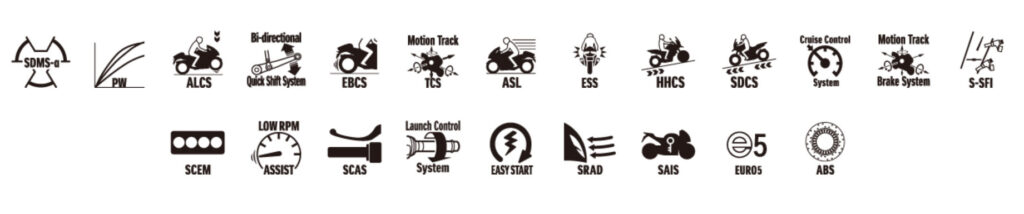
Suzuki Drive Mode Selector Alpha (SDMS-α) groups together various advanced electronic control systems while enabling riders to select individual settings for each. It optimizes performance characteristics and behavior to best suit varying road surfaces, riding conditions and preferred riding styles. Experiment with the different settings and benefit from the feedback each offers to hone your riding skills and build greater confidence while enjoying the ultimate riding experience.
Power Mode Selector
Select between three different engine output modes that control power delivery to match road and riding conditions. Mode 1 provides the sharpest throttle response and delivers maximum power. It’s a solid choice for the experienced rider out for a sporty run. Mode 2 provides softer throttle response and more linear power delivery. That makes it a practical mode for daily riding. Mode 3 provides the softest throttle response and features a more gentle power curve with reduced maximum output. It’s well suited to riding on wet or slippery roads, or while still getting used to the potential of the Ultimate Sport Bike.
Anti-lift Control System
Suzuki has successfully developed an advanced system that maximizes acceleration performance while preventing the front wheel from lifting off the ground. The system offers a choice of 10 mode settings when turned on, with Mode 1 providing minimal control and Mode 10 making it virtually impossible to lift the front wheel, even when fully opening the throttle with a passenger on the back.
Bi-Directional Quick Shift System
The system automatically interrupts power delivery just long enough—between 50 and 75 milliseconds, depending upon the sensitivity adjustment—to unload the transmission gear dogs and allow a clean upshift, producing smoother, almost uninterrupted acceleration. For quicker and smoother downshifts without manually blipping the throttle twist grip or using the clutch, the system automatically opens the throttle valves just enough to increase rpm and match engine speed to the next-lower gear ratio.
Engine Brake Control System
This system cancels out the effect of engine braking to suppress rear tire sliding or skipping and provide smoother, more controllable behavior. A choice of three modes plus an OFF setting let you control the effective strength of engine braking to match riding conditions or your preference.
Motion Track Traction Control System
Suzuki’s advanced Motion Track Traction Control System(TCS) allows the rider to select different levels of traction control intervention, depending upon road or racetrack conditions as well as personal preference and experience level. The Motion Track TCS continuously monitors front and rear wheel speed, throttle position, crankshaft position, gear position and motorcycle motion, and quickly reduces engine power output when a loss of traction is detected or predicted. Power output is controlled by managing ignition timing and throttle valve position.
Active Speed Limiter
A first in the motorcycle industry, this system lets you set a speed you do not wish to exceed and then accelerate and decelerate as you please up to that speed. This helps lessen worries about the bike exceeding your chosen speed limit.
Emergency Stop Signal
Another first on a motorcycle in Suzuki, this function rapidly flashes the front and rear turn signals to alert following vehicles if you brake suddenly at speeds of 55 km/h or higher. Note: Emergency Stop Signal is not available on North American, Indian or Canadian specification units.
Hill Hold Control System
When the vehicle stops on an upward slope and applies the brakes, this system automatically operates the rear brake for around 30 seconds to prevent the vehicle from backing down the hill even if the rider releases the brake lever/pedal. This allows the rider to focus on a smooth start on a hill.
Slope Dependent Control System
The Slope Dependent Control System constantly monitors the posture of the vehicle even when the vehicle is traveling downhill. When the rider operates the brake lever or pedal on a downhill, the electronic control unit controls brake pressure to prevent rear wheel lift.
Smart Cruise Control
Smart Cruise Control maintains a set speed without a rider operating the throttle. And it does this while allowing you to perform clutch-free gear shifts using the Bi-directional Quick Shift System without cancelling cruise control.
Motion Track Brake System
“Motion Track Brake System” by installing a Inertial Measurement Unit (IMU), and by combining the information of the posture of the vehicle with the front and rear wheel speeds, have made it possible for the ABS to activate not only in a straight line but also when the vehicle is leaning to either side.
Suzuki Side Feed Injector
Suzuki Side Feed Injectors (S-SFI) feature a new dual injector design that positions the secondary injector so its spray strikes a reflecting plate in the funnel and enters the combustion chamber as a fine mist. This combines with the increased capacity of a new air cleaner and longer intake pipe design to optimize low- to mid-range power output and make the Hayabusa more controllable in typical daily riding situations.
Suzuki Composite Electrochemical Material
Suzuki Composite Electrochemical Material (SCEM) is Suzuki’s own nickel-silicon-carbide coating technique derived from racetrack experience. SCEM cylinders allow faster heat transfer and tighter piston-to-cylinder clearance, for superb durability and resistance to scuffing.
Low RPM Assist
Low RPM Assist uses the ISC mechanism to help raise engine rpm slightly in launching and riding at low speed. This new feature helps smoother operation when pulling away and when riding at slow speeds, this means it’s easier to pull away and easier to control the engine in stop-start traffic.
Suzuki Clutch Assist System
Suzuki Clutch Assist System (SCAS) – a back-torque-limiting clutch helps make downshifts smoother, assists the rider in taking control in deceleration. Ramped engagement cams built into the clutch hub decrease force on the clutch plates under deceleration by pushing up against the pressure plate, allowing the plates to slip at a controlled rate.
Launch Control System
Launch control system makes it easier for a racer to get a good start in closed-course competition by automatically limiting engine rpm and optimizing torque delivery while the rider holds the throttle twist grip wide open and concentrates on feeding in the clutch lever.
Suzuki Easy Start System
On a normal motorcycle when starting the engine, the rider needs to press and hold the starter switch until the engine fires up. With the Suzuki Easy Start, all you need to do is one quick push of the starter switch, just like starting a modern car engine. The ECM recognizes the signals and keeps the starter motor working for a specified time.
Suzuki Ram Air-Direct
The Suzuki Ram Air-Direct (SRAD) air intakes are positioned close to the centerline of the fairing nose – the position offering optimum intake efficiency. This results in better intake efficiency, increase engine power in high speed.
Suzuki Advanced Immobilizer System
The Suzuki Advanced Immobilizer System (SAIS) uses an electronic identification system in the owner’s key to prevent unauthorized people from starting the engine. * Not available for North American spec.
EURO 5+
Only models with European specifications comply with EURO 5 emission regulations.
Antilock Brake System
An electrically controlled Antilock Brake System (ABS) that produces stable braking force under various road surface conditions. The system helps avoid wheel locking when there is a sudden change in road surface during braking or when an excessive braking force is applied. The system monitors wheel speed, and matches stopping power to available traction. * ABS is not designed to shorten the braking distance. Please always ride at a safe speed for road and weather conditions, including while cornering.
Ride-by-wire Electronic Throttle System
Butterfly valves on the throttle bodies are controlled by an advanced electronic engine management system.
ELIIY Power Lithium-Ion Battery
The battery offers superior output characteristics, resulting in strong starting performance. Its low self-discharge rate helps maintain reliable starting even during periods of non-use, such as during the rainy season, winter storage, and low-temperature conditions. As this is the first use of a lithium-ion battery on a Suzuki motorcycle, strict internal evaluation standards were established and met. The battery unit was also carefully engineered, with a focus on optimizing the overall design.